Loading…

NovelBrief · Novels
Xuanwu in Chinese Mythology: Star Chart to Living God
Xuanwu in Chinese mythology started as a star-sign marking north, became a tortoise-snake beast, then a real Ming-dynasty god still worshipped at Wudang.
5 min readBy Mei-Lin Zhao
Xuanwu in Chinese mythology gets filed under "one of the four guardian beasts" by most xianxia glossaries, and left there. That undersells it. The same name covers a star pattern, a hybrid animal, and a living god with a mountain temple complex still standing today.
TL;DR: Xuanwu in Chinese mythology began as a Han-dynasty astronomical marker for the north, became a tortoise-and-snake hybrid after the Han, and by the Ming dynasty had grown into Zhenwu, a major worshipped deity with an imperially funded temple complex at Wudang Mountain that still stands as a UNESCO World Heritage Site.
Xuanwu in Chinese Mythology: Key Takeaways
- Xuanwu is one of the Four Symbols (四象), the creatures assigned to the four cardinal directions and seasons in early Chinese astronomy; Xuanwu covers north and winter.
- The tortoise-and-snake combined image postdates the Han dynasty. Earlier depictions show only a tortoise.
- Song-dynasty Emperor Zhenzong ordered the name changed to Zhenwu around 997-1022 to avoid a naming taboo.
- The Ming dynasty's Yongle Emperor sponsored a major Wudang Mountain temple complex (1412-1424) after crediting Zhenwu with his military success, and that complex is still standing, now a UNESCO World Heritage Site.
Xuanwu in Chinese Mythology: A Star Pattern First
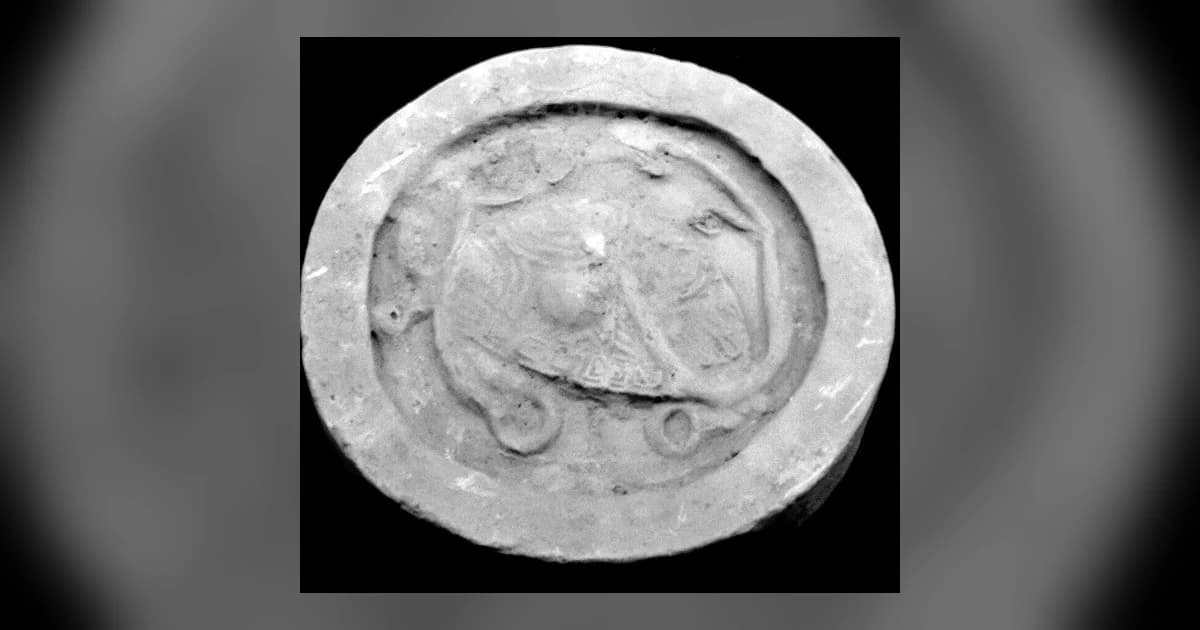
 A traditional Chinese wadang, a roof eaves-tile end, cast in relief with the Xuanwu tortoise-and-snake motif.
The earliest references to Xuanwu appear in Han-dynasty (206 BCE-220 CE) correlative cosmology, where it names one of the Four Symbols mapped onto the twenty-eight lunar mansions of Chinese astronomy. At this stage Xuanwu wasn't a creature with a personality or a temple. It was a direction-marker, one quarter of the sky assigned to north and winter, paired with the Azure Dragon (east, spring), Vermilion Bird (south, summer), and White Tiger (west, autumn). The animal imagery came before any narrative did.
The tortoise-and-snake combination that most readers picture is itself a later development. Depictions from before the Han dynasty show a plain tortoise. The hybrid form, a snake coiled around or fighting a tortoise, becomes the standard image only afterward, and it's that combined version carved into surviving wadang roof-tile ends and painted onto tomb murals across East Asia, including the well-documented Genbu mural in Japan's Takamatsuzuka tomb.
Curious how another "just an animal" myth turned out to have a second, unexpected life?
Taowu in Chinese Mythology: Monster and Book Title Both →
From Symbol to Zhenwu, a Living God at Wudang
Xuanwu's second transformation happened centuries later, during the Song dynasty (960-1279), when the cosmological symbol was personified into an actual deity with hagiographic stories, temples, and a place in Taoist ritual. The name itself changed during this period: Emperor Zhenzong (r. 997-1022) ordered it switched from Xuanwu to Zhenwu to avoid a naming taboo tied to a claimed imperial ancestor. Zhenwu stuck as the more common name for the god going forward, even though Xuanwu remained the standard term for the older astronomical symbol.
The bigger transformation came under the Ming dynasty's Yongle Emperor (r. 1402-1424), who credited Zhenwu with divine assistance during his 1399-1402 military campaign to seize the throne. As emperor, he sponsored a massive construction program in the Wudang Mountains of Hubei between 1412 and 1424, building an elaborate temple complex that became the institutional center of Zhenwu worship. That complex earned UNESCO World Heritage status in 1994 and worship spread further south through migration into Qing-dynasty and modern Southeast Asian communities. A star pattern from a Han-dynasty astronomy text ended up as one of the most consequential gods in Chinese religious history, actively worshipped today, not just a name in an old book.
Want the third piece of this mini-series, the myth behind xianxia's giant sky-spanning beast?
Kunpeng: The Myth Behind Xianxia's Giant Sky Beasts →
Xuanwu's Afterlife in Xianxia and Wuxia Fiction
Cultivation and wuxia fiction almost always borrows Xuanwu at the first stage, the astronomical guardian-of-the-north symbol, not the Zhenwu deity stage. A "Xuanwu Sect" or "Xuanwu technique" in a novel is usually signaling defense, endurance, or a northern territorial claim, drawing on the tortoise's traditional association with longevity and a fortified shell rather than on the Ming-dynasty imperial cult around Zhenwu. That's a reasonable creative choice, the Four Symbols framework is a clean, pre-built compass for assigning four sects or four artifacts to four directions, but it also means most readers encounter only the emptiest version of the name: a label for "north" and "tough," with none of the actual fifteen-century journey behind it.
Readers who want the fuller picture, that Xuanwu is simultaneously an ancient star chart, a tortoise-snake hybrid, and a still-worshipped mountain god, are getting a more accurate sense of just how much real history web-fiction borrows and simplifies down to a faction name.
Frequently Asked Questions
Q: What is Xuanwu in Chinese mythology? A: Xuanwu is one of the Four Symbols, a set of four creatures assigned to the four cardinal directions in early Chinese astronomy. Xuanwu represents the north and winter, usually shown as a tortoise with a snake coiled around it.
Q: Is Xuanwu a tortoise or a snake? A: Both, combined. Before the Han dynasty, depictions show only a tortoise. After the Han, the tortoise-and-snake combined form became standard, and it's this pairing that appears in most later art.
Q: Why is Xuanwu also called Zhenwu? A: Song-dynasty Emperor Zhenzong (r. 997-1022) ordered the name changed from Xuanwu to Zhenwu to avoid a naming taboo, since one of his claimed ancestors reportedly shared a character with the original name. Zhenwu remained the more common name for the personified deity afterward.
Q: What is Xuanwu's connection to Wudang Mountain? A: The Yongle Emperor, who credited Zhenwu with helping his 1399-1402 military campaign, sponsored a massive temple-building program at Wudang Mountain between 1412 and 1424. The complex became the center of Zhenwu worship and is now a UNESCO World Heritage Site.
Q: Does Xuanwu appear in xianxia or wuxia fiction? A: Yes, usually as a guardian-beast name for a sect, clan, or cultivation technique tied to the north or to defense, alongside the other three Symbols (Azure Dragon, White Tiger, Vermilion Bird).
Related Reading
References

About the author

Danmei & Genre Critic
Danmei and xianxia critic with a background in comparative literature, writing about Chinese web fiction in English since 2019. Toronto-based.
- Writing about danmei and xianxia in English since 2019
- Graduate background in comparative literature
- Tracks the fan-translation-to-official-license pipeline
- Follows Seven Seas' convention announcements directly
Keep reading

Taowu in Chinese Mythology: Monster and Book Title Both
Novels · 5 min

Kunpeng: The Myth Behind Xianxia's Giant Sky Beasts
Novels · 6 min

Coiling Dragon Review: Linley’s Classic Still Holds Up
Novels · 11 min
A Will Eternal Reading Guide: Start Bai Xiaochun's Journey
Guides · 11 min

Reverend Insanity Reading Guide: Start Here, Finish Strong
Guides · 11 min

Reverend Insanity Character Guide: Who's Who, Spoiler-Safe
Guides · 10 min

Novels Like Reverend Insanity, Picked by Protagonist Type
Novels · 5 min

Best Xianxia Novels With Romance Worth Reading in 2026
Novels · 5 min
Disclaimer
This article is published for informational and entertainment purposes. It does not constitute professional financial, legal, or technical advice. Series availability, platform access, translation status, and chapter counts change. Verify critical details (pricing, regional availability, official translation status) with publishers and platforms. Affiliate links, where present, help support our editorial work and are labelled in our affiliate disclosure.
Comments
Loading comments…