Loading…

NovelBrief · Guides
Reverend Insanity Character Guide: Who's Who, Spoiler-Safe
This Reverend Insanity character guide helps returning readers separate the Qing Mao Mountain cast without replacing a review or reading order.
10 min readBy Daniel P. Cross

Readers coming back to Reverend Insanity after hundreds of chapters often remember a scene's tension before they remember who belongs to which clan or family. That's normal for a serial built on repeated surnames and shifting allegiances. This is a character reference, not a review or reading order, starting with the cast that makes the Qing Mao Mountain opening legible.
TL;DR: Use this Reverend Insanity guide to reset the early cast: Fang Yuan is the calculating focal point, Fang Zheng is his younger brother, Bai Ning Bing is the dangerous rival, and the Gu Yue clan elders are a family-and-clan power structure rather than interchangeable background names. Keep your place by chapter and arc, then look up only the names already on your page.
Why a Reverend Insanity Character Guide Helps
The problem is not that Reverend Insanity lacks introductions. It is that its names carry several kinds of information at once. A surname can signal family connection; a clan title can signal rank; and a later scene can change how an earlier person reads. When you return after a long pause, a generic character wiki can solve the first problem by creating the second: it may reveal an identity, death, alliance, or cultivation change you have not reached.
Reader discussion on r/noveltranslations has called out the confusing effect of the naming conventions and the need to reread when starting out. That is a useful, modest insight, not proof that the cast is badly written. In Reverend Insanity, family names and formal titles are part of the setting's social logic. The trick is to preserve that logic while giving yourself a small set of anchors.
Use this page as a return ramp. It covers the opening-clan cast first, gives only role-level descriptions, and avoids pretending that a 2,000-plus-chapter serial can be reduced to a single permanent ranking. For a verdict on the book's tone and antihero lead, use our Reverend Insanity review. For the actual chapter sequence, use the separate Reverend Insanity reading order.
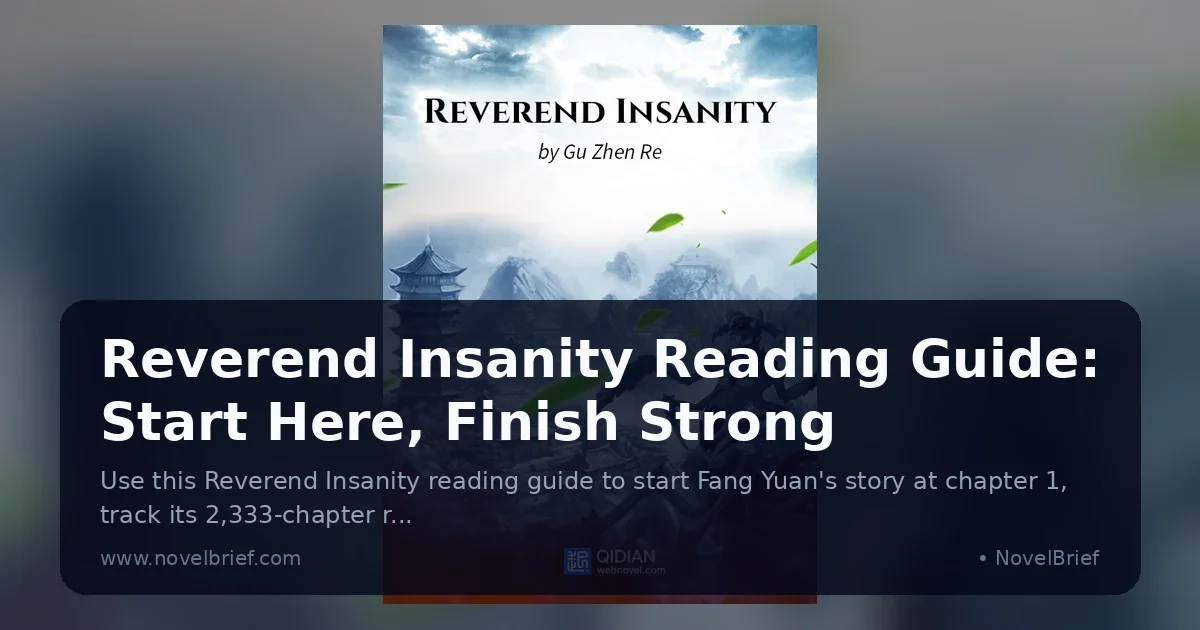
 Cover: official Webnovel edition of Reverend Insanity.
The Reverend Insanity Quick Reference: Qing Mao Mountain
The earliest part of Reverend Insanity gives you the best place to rebuild recognition. Treat the Gu Yue clan not as one person but as a structure: blood relatives, clan leadership, elders, and younger cultivators all operate under the same clan name. The following labels are deliberately short. They are meant to help you re-enter a chapter, not to tell you where any character ends up.
| Character | Safe early-arc identifier | What to remember on return |
|---|---|---|
| Fang Yuan | The central point-of-view cultivator | His decisions set the plot's moral temperature; do not mistake strategy for a neutral narrator. |
| Fang Zheng | Fang Yuan's younger brother | Similar name, different person. His position in the clan puts sibling comparison at the story's center. |
| Bai Ning Bing | A talented early rival from outside Fang Yuan's immediate family | The name marks a threat and a foil, not a Gu Yue relative. |
| Gu Yue Bo | Clan leader in the opening setting | Read the title as institutional power first, family detail second. |
| Gu Yue Qing Shu | An orphan raised by Gu Yue Bo | He is connected to the clan leadership, but he is not Fang Yuan's brother. |
Fang Yuan: the reference point, not the moral compass
In Reverend Insanity, Fang Yuan is the figure through whom the early world rules become visible. The official Webnovel description frames him as a cultivator with memories from a previous life. That premise explains why he can read opportunities and people with unusual confidence. It does not make every conclusion he reaches objective.
When resuming a chapter, ask two separate questions: what does Fang Yuan know, and what does he want? Keeping those questions apart makes later manipulations easier to follow. It also stops the common memory error of treating a plan he considers as an event that has already happened.
Fang Zheng: the brother readers confuse with the protagonist
Fang Zheng is Fang Yuan's younger brother, not an alternate name for Fang Yuan. In the official English chapter 105 listing, his place in the Gu Yue clan's succession context is explicit. His relationship to the protagonist supplies an early emotional and political contrast: the two are close enough in name and status to be compared, yet their paths and social reception differ.
If you remember only one distinction from this Reverend Insanity character guide, make it this one. “Fang” is the shared family name. “Yuan” and “Zheng” are the names that tell you which brother is on the page. Save the chapter number when a family confrontation occurs; a vague note saying “Fang brother scene” is not enough.
Bai Ning Bing: the rival who is not a clan sibling
Bai Ning Bing enters the early story as a formidable counterweight to Fang Yuan. Official chapter listings place Bai Ning Bing in the Qing Mao Mountain conflict and identify a direct confrontation with Gu Yue Qing Shu. That is the useful return-reader fact: the character belongs in the immediate danger of the opening arc, but not inside Fang Yuan's brother relationship or the Gu Yue family tree.
Do not turn “rival” into a permanent, spoiler-heavy label. In a long Reverend Insanity serial, a role can change before a character's core traits do. For a safe refresher, remember the early function rather than searching an end-state summary.
Gu Yue Bo and Gu Yue Qing Shu: leadership versus kinship
The Gu Yue name is where many early notes become muddy. Gu Yue Bo is the clan leader. Gu Yue Qing Shu is an orphan raised by him and a clan-leader candidate in the official chapter 105 material. That is enough to keep the first hierarchy straight: authority, adoption, and clan membership overlap, but they are not identical relationships.
When an elder speaks in Reverend Insanity, write down the title and function beside the name. “Clan leader,” “elder,” and “candidate” are more useful breadcrumbs than trying to memorize every early appearance. They also make it easier to see when an argument is personal and when it is institutional.
New to the genre terms around clans, sects, and cultivation?
What Is Xianxia? A Beginner's Guide →
Step-by-Step
-
Save your exact chapter before taking a break. Add the chapter title if your reader shows one. A remembered arc name can be helpful, but it is less precise than the text's own navigation.
-
Name the scene's power structure first. Is this a family interaction, a Gu Yue clan decision, or a confrontation with a rival? That one label narrows the field before you look up a person.
-
Separate shared surnames from individual names. In Reverend Insanity, “Fang” does not mean Fang Yuan, and “Gu Yue” does not mean a single character. Write both parts of a name in your notes.
-
Read the early-role description only. Use the table above before opening an exhaustive database. If the name is not listed, return to the last paragraph you read and collect a role clue from the text itself.
-
Stop your lookup at your current chapter. A character page that begins with “later,” “true identity,” or a long list of appearances is not a safe tool for a first-pass reminder. Close it and continue with your own notes.
-
Update a three-line cast note after a major turn. Keep protagonist, ally or rival, and institution in separate lines. That is enough structure for Reverend Insanity without making reading feel like homework.
How to Use This Reference After Chapter 900
Past the early arcs, a Reverend Insanity character guide should become more cautious, not more encyclopedic. A person you met long ago may return with a different alliance, title, or level of knowledge. A neat one-line definition can be actively misleading if it freezes them at the point where you last saw them.
The safest return routine has two layers. First, record where you stopped: chapter, location or arc label, and the last concrete action. Second, record relationships as they stand there: “currently helping,” “currently opposed,” or “unclear.” The word “currently” matters. It makes a note useful without smuggling in later outcomes.
This is also why the Reverend Insanity guide does not present a giant “strongest characters” ladder. A power ranking may be entertaining, but it answers a different search intent and tends to expose later-stage information. Readers returning after chapter 900 usually need orientation, not a contest result. If you want a refresher on the Gu-centered system rather than the cast, our xianxia versus wuxia explainer is the better detour.
A Spoiler Budget That Actually Works
Set a spoiler budget before you search. For a normal return after a short break, allow yourself only the character's first-known role and the last scene you personally read. For a much longer break, add a brief arc recap from a source that clearly labels its chapter range. Do not jump to an image search, a “best moments” list, or a comment thread; thumbnails and offhand jokes routinely disclose more than an ordinary summary.
In practice, good Reverend Insanity notes look almost boring: “Fang Zheng, younger brother, succession pressure, chapter 105 context.” They are useful because they restore the question you had when you closed the book. A note such as “important later” is not useful, and a note that names a future side is worse than nothing.
The same principle helps with official sources. The Webnovel chapter pages are valuable for checking an early name and scene, but opening a very late chapter to confirm a detail would defeat this guide's purpose. Use a chapter close to your progress, then return to the novel. That boundary keeps a reference from becoming accidental criticism, plot summary, or reading route.
Want a gentler companion to the dense serial form? explains the format difference without assuming one is superior.
Web Novel vs. Light Novel →
Frequently Asked Questions
Is this a spoiler-free Reverend Insanity character guide?
It is spoiler-conscious rather than spoiler-free. It identifies the early Qing Mao Mountain cast and focuses on how to look up later names without reading their outcomes.
Who is Fang Yuan?
Fang Yuan is the central character of Reverend Insanity, a reborn Gu cultivator whose choices drive the early clan conflict.
Are Fang Zheng and Fang Yuan the same person?
No. Fang Zheng is Fang Yuan's younger brother. Their similar names are one reason a compact reference helps.
When should I use this guide?
Use it after a break, before resuming an early arc, or whenever similarly named clan characters begin to blur together.
Does this replace the Reverend Insanity reading order?
No. The reading-order guide tells you how to begin and continue. This page is a cast reference.
Related Reading
- Reverend Insanity Review
- Reverend Insanity Reading Order
- What Is Xianxia? A Beginner's Guide
- Wuxia vs. Xianxia: What's the Difference?
- Web Novel vs. Light Novel
References
Was this guide helpful?
About the author

Senior Reviewer & Reading Guide Editor
Web novel reviewer and critic with a decade covering translated Chinese fiction, from fan-translation forums to official Webnovel.com releases. London-based.
- 10 years reviewing translated web fiction, official and fan-translated
- 600+ novels read to completion or a confident drop point
- Specializes in translation-quality and pacing assessment
- Tracks reading-order pitfalls in 1,000+ chapter novels



Disclaimer
This article is published for informational and entertainment purposes. It does not constitute professional financial, legal, or technical advice. Series availability, platform access, translation status, and chapter counts change. Verify critical details (pricing, regional availability, official translation status) with publishers and platforms. Affiliate links, where present, help support our editorial work and are labelled in our affiliate disclosure.
Comments
Loading comments…